
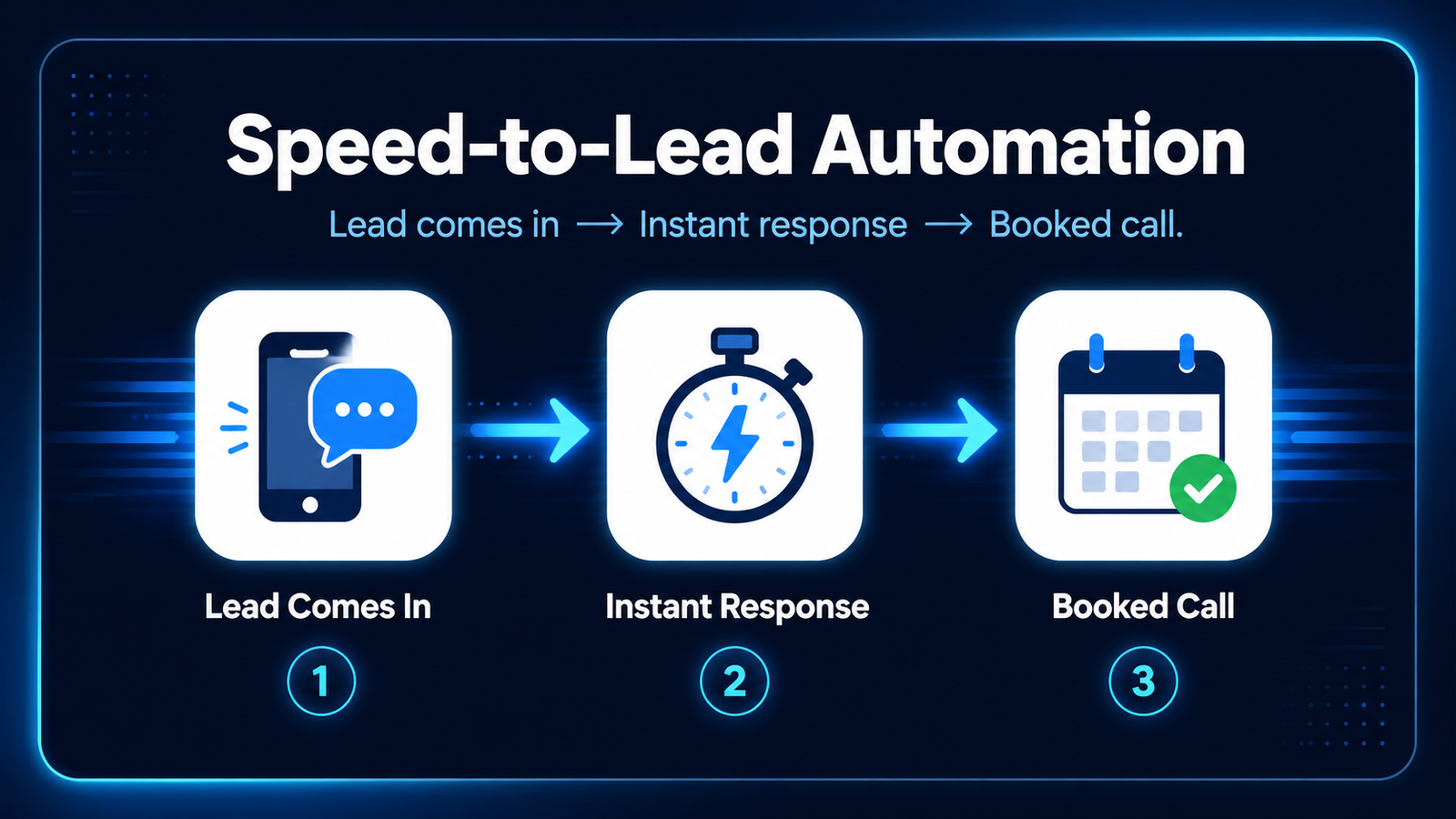
The business that wins the deal usually isn’t the cheapest or even the best — it’s whoever responds first. Every minute a new lead sits untouched, the odds of ever reaching them get worse, not the same. Speed-to-lead automation is the system that makes sure a lead gets a response in seconds instead of hours, so interest doesn’t have time to cool off before someone from your business shows up. For Virginia Beach and Hampton Roads businesses, that usually means booking more of the leads you’re already paying for — without hiring anyone new to sit by the phone.
Why the first five minutes decide almost everything
Research from MIT and InsideSales.com, tracking over 15,000 leads and 100,000 call attempts, found that a business contacting a lead within five minutes is roughly 100 times more likely to actually reach them than one that waits thirty minutes — and about 21 times more likely to qualify that lead at all. The decay isn’t gradual. It’s steep, and it starts immediately.
Under 5 Minutes
The window where contact and qualification odds are highest. Most businesses never hit it.
30 Minutes
Contact odds have already dropped sharply. The lead is likely comparing other options.
24 Hours
The lead has often already chosen someone else. A reply here rarely converts.
What should be in a speed-to-lead system?
Speed alone isn’t enough if the response feels robotic or the lead still waits on a real answer. A real system responds fast and routes smart.
Instant Acknowledgment
An automatic reply within seconds so the lead knows they were heard.
Smart Routing
The right lead reaches the right person, calendar, or AI agent immediately.
Human Handoff
Once interest is confirmed, a real person or booked call takes it from there.
Which leads decay fastest?
Not every lead cools at the same rate. Paid and impulse-driven leads decay fastest; warm, referred leads are more forgiving — but none of them get more patient with time.
Paid Ad Leads
Actively comparing options right now. Slow response loses them fastest.
Website Form Fills
High intent, but attention fades within minutes of submitting.
Missed Calls
They called instead of texting — they wanted to talk now, not later.
Chat & Text Inquiries
Expect a reply speed that matches the channel: fast.
What good speed-to-lead automation should measure
Response speed only matters if it's actually tracked. A good system gets judged on outcomes, not on whether a message technically went out.
Time to First Contact
How long between a lead arriving and a real response reaching them.
Contact Rate
How many leads actually get reached at all, on any channel.
Booked-Call Rate
How many contacted leads turn into a scheduled call or estimate.
How the speed-to-lead flow works
Lead Arrives
Call, form, text, or chat — every channel feeds the same system.
Instant AI Reply
A response goes out in seconds, day or night, weekday or weekend.
Route to Human
Interested replies get handed to the right person or booked directly.
Track Outcome
Response time, contact rate, and booked calls all get measured.
The real cost of a slow response nobody notices
A 2011 Harvard Business Review audit of 2,241 companies found the average business takes 42 hours to respond to a new lead — and nearly a quarter never respond at all. None of that shows up as a single dramatic failure. It shows up as ad spend that quietly underperforms, referrals that go cold, and a sales pipeline that always feels thinner than the traffic numbers suggest.
That’s why speed-to-lead isn’t a nice-to-have feature. It’s the difference between a lead becoming a customer and a lead becoming a competitor’s customer.
⚠️ What Usually Goes Wrong
Someone eventually calls back — just hours after the lead already booked with someone else.
✅ What Makes It Work
A response goes out in seconds, and a real person picks it up while interest is still warm.
Why this matters in Virginia Beach and Hampton Roads
Virginia Beach businesses are competing in a market where people request three or four quotes in the same afternoon. Whoever answers first usually gets the appointment, regardless of price. Across Hampton Roads, that pattern holds even more — commuters and dual-income households research and decide fast, often outside normal business hours, and a business that only responds 9-to-5 is invisible for the other two-thirds of the day.
How this works across Hampton Roads, not just Virginia Beach
The same urgency applies in Chesapeake, Norfolk, Portsmouth, Suffolk, Hampton, and Newport News. Local buyers don’t wait around for a callback between cities any more than they do within one. That’s why the strongest speed-to-lead systems aren’t tied to office hours — they respond the same way at 7 a.m., 7 p.m., or midnight on a Saturday.
The lead that got away in fourteen minutes
It rarely looks like a crisis. A homeowner fills out a quote form on a Tuesday afternoon, then goes back to their day. Fourteen minutes later, they get a call — not from the business they just contacted, but from a competitor who happened to respond first. By the time the original business calls back an hour later, the job’s already booked.
Nobody on the original team did anything wrong, exactly. The form sat in an inbox. The team was mid-job, phones down. The callback happened the same day, which felt reasonable. It just wasn’t fast enough, and in a market where three other businesses got the same inquiry, reasonable doesn’t win.
The Hidden Problem
“We called back the same day” still loses to whoever called back in minutes.
The Better Move
Automate the first response so speed never depends on who’s free right now.
What a complete speed-to-lead system should do before the first lead ever comes in
Before turning it on, the response, the routing, and the handoff should all already be mapped out.
- Connect every lead source — calls, forms, chat, and text — into one system
- Set an instant automated first response, day or night
- Route interested replies to a real person or a booked calendar slot
- Build an escalation path for leads nobody has touched yet
- Track time-to-first-contact and booked-call rate, not just lead volume
Is It Worth Fixing?
Which NyneCom path fits your business?
Once the math checks out, there are two ways to put a speed-to-lead system to work — pick based on how hands-on you want NyneCom to be.
AI Eco System
Instant AI response, routing, and reminders layered into your CRM — built for teams that want speed without a full leadership hand-off.
Explore AI Eco System →Elite C Suite
$5,000/month + 10% of trackable profit generated. Full fractional AI leadership across CRM, automations, and revenue systems — NyneCom runs it end to end.
See Elite C Suite →
Built by Reginald “Reggie” Pinckston
Reggie leads NyneCom’s work across CRM, automation, and revenue-focused AI systems, helping Virginia Beach businesses turn slow response times into booked appointments and repeat revenue.
How to make speed-to-lead automation safer and easier to measure
Speed-to-lead and database reactivation solve two ends of the same problem — one catches leads the moment they arrive, the other recovers the ones that already went cold. If your team hasn’t tackled the second half yet, it’s worth reading how database reactivation turns old leads and past customers back into booked appointments. For the research behind response-time benchmarks, this B2B lead response time study breaks down the data in more depth, and this lead response time research roundup is a useful reference for how the most-cited stats are sourced.
Frequently Asked Questions
What is speed-to-lead automation?
It’s a system that responds to a new lead — call, form, text, or chat — within seconds instead of hours, then routes interested replies to a real person or booked call.
How fast should a business respond to a lead?
Under five minutes gives the best odds of reaching and qualifying the lead. Response speed drops off sharply after that.
Does automation replace a real conversation?
No — it handles the first response and routing so a real person can pick up the conversation while the lead is still warm.
Where does AI fit in?
AI handles the instant first reply and routing around the clock, then hands qualified leads off to a person or a booked calendar slot.
Some links below are affiliate links. If you sign up through them, NyneCom may earn a commission at no extra cost to you.



Ready to stop losing leads to response time?
See what a five-minute response system could book that a next-day callback never will.