
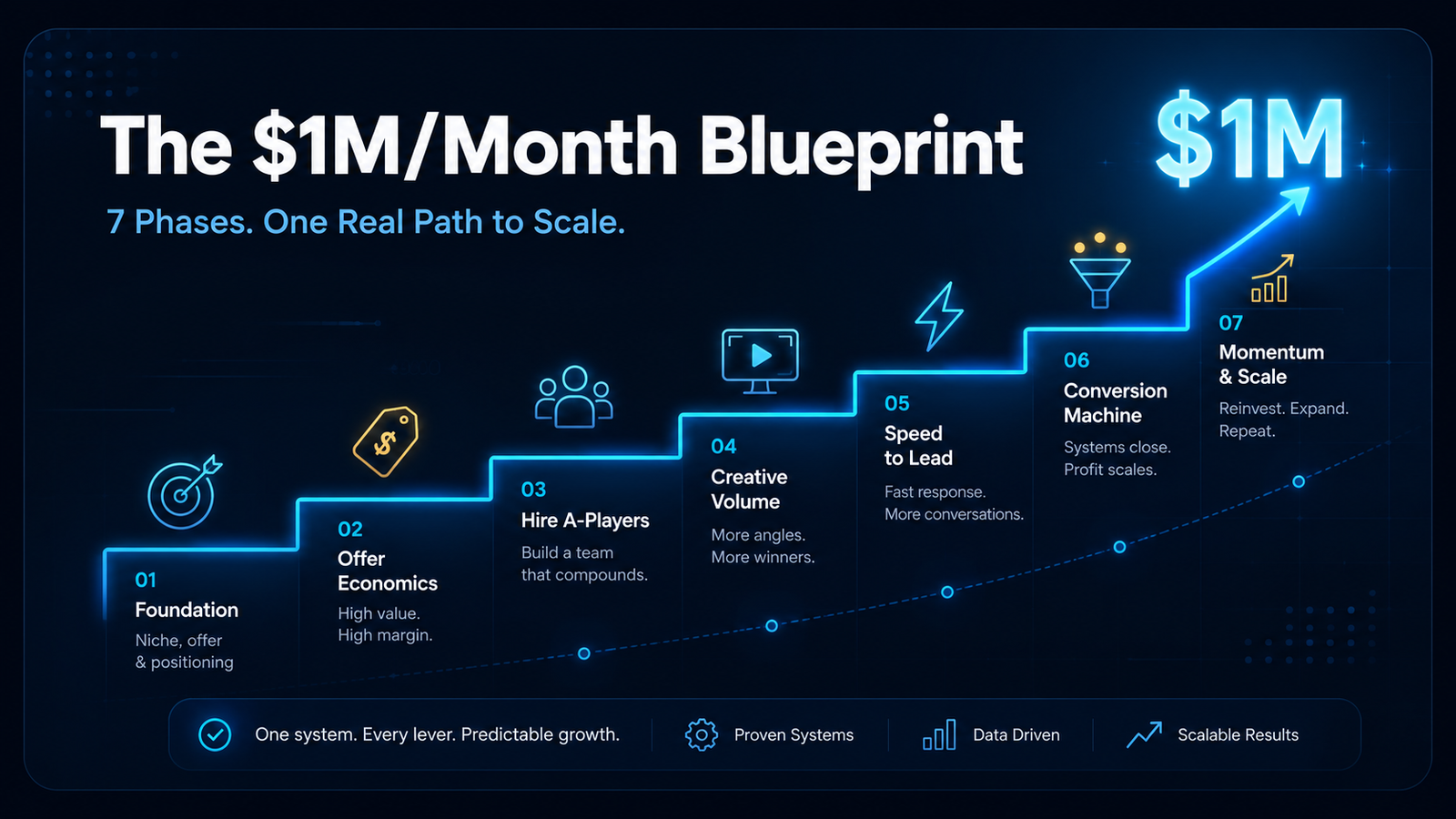
Most businesses that hit $1M+ months aren’t doing anything magical. They’re executing a small set of proven principles relentlessly, while most of their competitors quietly sabotage themselves with the same handful of mistakes. This is a complete, transparent blueprint — every phase, laid out plainly enough that you or your team could run it without us. Bookmark it, print it, hand it to your ops manager. That’s the point.
The blueprint at a glance
Seven phases, in order. Skipping one doesn’t just slow you down — it usually caps how high the rest can take you.
Offer Economics
A-Player Team
Creative Volume
Speed-to-Lead
Press the Gas
Expect ROAS Swings
Break Limiting Beliefs
Phase 1: Fix your offer economics before you scale anything
No amount of traffic or team fixes an offer that doesn’t make sense financially. Before touching ad spend or headcount, know your real numbers — not the surface-level ones.
True Cost Per Acquisition
What it actually costs to land a customer, all-in — not just the ad spend line.
Real Lifetime Value
What a customer is actually worth once repeat business and referrals are factored in.
The Number That Actually Matters
A cost-per-call that looks expensive on the surface can still be wildly profitable once the full backend math is run. Judge the offer on the real model, not the sticker shock.
Phase 2: Build a team of A-players — and never mix them with B-players
This is one of the most consistent lessons behind businesses that scale past seven figures a month: A-players and B-players operate at completely different speeds, judged by completely different standards. One group measures itself on results. The other just wants a paycheck. Mix them, and the A-players leave — every time.
Hire Slow, Fire Fast
Mediocrity that’s tolerated becomes the new standard for everyone around it.
Judge on Results, Not Effort
A-players want to be measured. That’s exactly why they’re A-players.
Protect the Standard
One B-player hire can quietly reset the bar for an entire team.
Phase 3: Flood the market with creative and content volume
Businesses running two or three ads for months plateau. The ones scaling past $1M a month treat creative as a renewable input — new concepts entering testing constantly, not just when performance dips. We broke this down in full in our Meta ads operating model post, including why flooding cold audiences with useful content before the pitch outperforms a single cold sales ad every time.
Phase 4: Make speed-to-lead non-negotiable
Every dollar spent scaling traffic is wasted if the leads it generates sit unanswered. A business that responds within five minutes is dramatically more likely to convert a lead than one that waits thirty. At scale, this isn’t optional — it’s the difference between traffic that pays for itself and traffic that quietly bleeds money. Full breakdown in our speed-to-lead automation post.
Phase 5: Press the gas when something's actually working
One of the more expensive lessons in scaling: when a main offer is printing money, that’s exactly the wrong moment to get distracted launching secondary and tertiary offers, or to assume the winning offer is about to die and needs replacing. One documented case saw a business go from $300K to $2.5M a month in eight months by doing exactly one thing well — then collapse back to $500K–$600K a month after diversifying attention, buying unrelated businesses, and hiring dozens of B and C-players overnight who clashed with the A-players already in place.
The lesson wasn’t complicated. Don’t diversify attention while you’re printing money. Don’t let anxiety about an offer’s lifespan become a self-fulfilling prophecy. And never let team quality slip while scaling fast — that’s exactly when it matters most.
Phase 6: Expect your ROAS to fluctuate — don't panic when it does
Most businesses stall out because they hit a return that feels good and stop pushing, or they see return on ad spend dip and immediately pull back. Real scaling looks more like moving from a tightly in-market audience, to a needs-convinced audience, to eventually the mass market — and the return on each dollar spent shifts at every stage. A ratio might drop from 10:1 down to 3:1 before climbing back to 7:1 at a much larger scale. The number moves. The total dollars made keeps growing the entire time.
Phase 7: Break your limiting beliefs about market size and team capacity
A common pattern in businesses that plateau: they talk themselves out of a bigger market before ever actually testing it. One documented example involved a business selling a $15,000 offer to a niche of about 10,000 real estate agents, while a market of roughly 3 million other agents sat untouched — because the team had already decided, without ever trying, that it wouldn’t work there.
The same business believed it could never scale past two closers. When asked if they’d ever actually had six, the answer was no — they’d tried four once, two left within a month, and the belief calcified from there. Most capacity ceilings aren’t real. They’re just untested assumptions that never got questioned.
Three levers that make this blueprint cheaper and faster
The seven phases above are the core system. These three levers aren’t replacements for it — they’re accelerants that cut cost and speed up how fast the rest of the blueprint compounds.
Lever 1: Cut your acquisition cost to near $0
Every phase above assumes you’re paying to acquire traffic. You don’t always have to. Infinite shared postcard marketing lets you split the cost of a recurring mailer across several non-competing businesses, which can push your own out-of-pocket cost down to $0 once the shared-cost math is working — sometimes cheaper than the paid ad spend most businesses use just to get someone onto a page with tracking pixels in the first place.
That’s exactly why the landing page you send that mail traffic to matters. Give it its own separate batch of tracking pixels — not the same pixel setup running on your paid ads — so you can actually isolate how much revenue this specific channel produces instead of blending it into your paid traffic numbers. Once that’s visible, push that cheap or free traffic through a sequence of genuinely helpful content instead of one pitch. That’s what turns near-free traffic into real conversions — not the cost of the click, but how many times someone sees something useful from you before they’re ever asked to buy.
Lever 2: Reactivate what you already have, on two angles at once
Database reactivation is one of the fastest levers to add once you’re actively scaling, because it runs on two separate angles at the same time:
The Old List
Past customers and dormant leads sitting untouched for months or years. Cost to re-approach them is close to $0 — you already paid to acquire them once.
Recent Fell-Through Leads
Leads from the last 30–60 days that never got a real follow-up. Still warm, often easier to close than the old list, and just as neglected.
Run Both at Once
You’re recovering revenue from two completely different points in the pipeline, without spending anything new on traffic.
Lever 3: Add a referral engine
Referral programs are one of the most underused levers in this entire blueprint. Referred customers convert roughly 2x more often than leads from paid channels, retain about 37% longer, and carry close to 16% higher lifetime value. Double-sided programs — where both the referrer and the new customer get rewarded — generate about 53% more referrals than single-sided ones. And the opportunity is wide open: more than half of businesses still don’t run any kind of formal referral program at all.
We break down exactly how to build one — the offer structure, the software, the mistakes that kill most programs before they start — in a dedicated post: how to build a referral program that actually generates leads.
*Based on U.S. Bureau of Labor Statistics business survival and growth data, cited publicly by direct-response marketers discussing million-dollar-month case studies. Illustrative, not a guarantee — most of what separates the businesses that get there is process, not luck.
⚠️ What Usually Goes Wrong
A business hits a good month, gets comfortable, and stops pressing on what’s actually working.
✅ What Makes It Work
Real numbers, an A-player team, constant creative volume, and the discipline to keep pushing through the dip.
Why this matters in Virginia Beach and Hampton Roads
Most local businesses never test whether their real ceiling is higher than they assume — they cap their own growth with the same untested beliefs about market size and team capacity described above. The businesses that break past seven figures a month locally are usually doing the same seven phases everyone else skipped, not something exotic.
What a complete $1M/month system should have in place
- Real CAC and LTV numbers, not surface-level estimates
- A hiring bar that never mixes A-players with B or C-players
- A constant pipeline of new creative and content, not two ads on repeat
- Instant lead response, every channel, day or night
- A plan to keep pressing a winning offer instead of diversifying too early
Is It Worth Building?
Which NyneCom path fits your business?
You can run this entire blueprint yourself with your own team — that’s the point of it being fully transparent. If you’d rather have help building or running it, there are two ways to work with NyneCom.
AI Eco System
Every tool this blueprint needs — CRM, automation, AI follow-up — plus an AI coach built in to help your team run it yourselves.
Explore AI Eco System →Elite C Suite
$5,000/month + 10% of trackable profit generated. We build and run all seven phases for you — full fractional CFO, COO, CMO, and AI Officer.
See Elite C Suite →
Built by Reginald “Reggie” Pinkston
Reggie leads NyneCom’s work across CRM, automation, and revenue-focused AI systems, helping Virginia Beach businesses build real scaling systems instead of chasing shortcuts.
How to use this blueprint safely
Every phase here works together. A team of A-players with no speed-to-lead system still loses deals to slower follow-up. Great creative volume with a broken offer still loses money. If you want the fuller picture on any single phase, we’ve broken each one down separately: database reactivation, speed-to-lead automation, missed-call text-back, infinite shared postcard marketing, and our Meta ads operating model.
Frequently Asked Questions
Is this connected to Jeremy Haynes or Megalodon Marketing?
No. This blueprint describes publicly discussed scaling principles associated with Jeremy Haynes, adapted independently by NyneCom. We are not affiliated with, endorsed by, or sponsored by him or Megalodon Marketing.
Can I actually run this blueprint myself?
Yes — every phase is laid out transparently enough for you or your team to execute without us. That’s intentional.
What's the single biggest reason businesses stall before $1M a month?
Usually one of two things: they get comfortable at a good-but-not-great number and stop pressing, or they mix A-player hires with B and C-players and watch the standard erode.
Where does AI fit into this blueprint?
AI handles the speed-to-lead response, follow-up, and routing across every phase, so the human team can focus on offer, creative, and hiring decisions instead of manual busywork.
Some links below are affiliate links. If you sign up through them, NyneCom may earn a commission at no extra cost to you.



Ready to build your own path to $1M a month?
Run the blueprint yourself, or let us build and run it for you.