
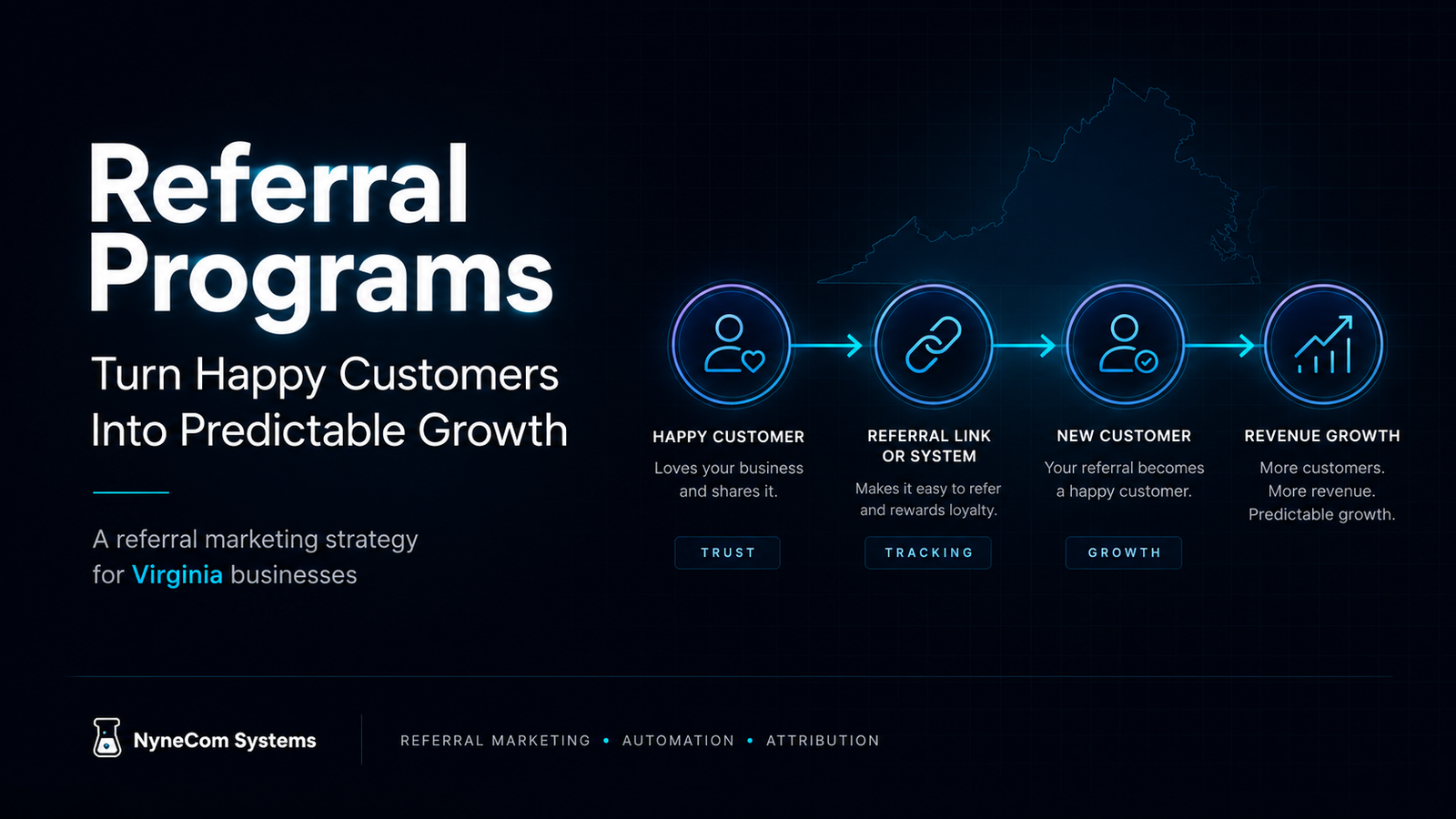
Referral Programs: The Marketing Strategy That Turns Happy Customers Into Predictable Growth
A practical guide for Virginia businesses that want to generate more qualified leads, lower acquisition costs, and track every referral from introduction to revenue.
Most businesses say referrals are their best source of customers, yet very few operate a real referral marketing system. They wait for customers to remember them, hope someone makes an introduction, and rarely track which advocates, offers, or channels produce revenue. A structured referral program changes that. It gives satisfied customers a clear reason to share, makes the process easy, tracks attribution, and rewards the right action only after a qualified result occurs.
The problem at a glance
Referrals already outperform almost every other channel a business runs — referred customers convert faster, stay longer, and cost less to acquire than leads from paid ads or cold outreach. The problem isn’t that referrals don’t work. It’s that most businesses never build a real system around them, so the advocates willing to refer never get asked, and the ones who do refer someone have no easy way to actually do it.
The Ask Is Inconsistent
Teams ask at random, use different language, and often wait until the customer relationship has gone cold.
Sharing Takes Too Much Effort
Customers are told to “send someone our way” without a link, landing page, message, code, or clear next step.
Nobody Can Prove the ROI
Leads enter the CRM without attribution, rewards are handled manually, and the program cannot be optimized.
Why this problem costs more than most businesses realize
An unstructured referral process creates three hidden losses. First, satisfied customers who would gladly recommend you never receive a timely prompt. Second, referred leads receive the same generic experience as cold traffic even though they arrive with more trust. Third, the business cannot identify its best advocates or calculate the real cost of acquisition.
Consider a Virginia service business that completes 100 successful customer engagements each month. If only a small portion of those customers are willing to introduce one qualified person, the opportunity is meaningful. But without a system, the company may capture only a handful of those introductions. The constraint is often not customer satisfaction. It is operational friction.
How the system works
A strong referral program follows a simple operating loop: identify the right moment, make a relevant offer, give the customer an easy sharing method, capture the referred lead, qualify the outcome, and issue the reward according to clear rules. Referral Factory is one example of software designed around this workflow, with branded referral pages, promotion tools, tracking, qualification, rewards, and integrations.
Choose the Trigger
Ask after a positive milestone: a successful delivery, a five-star review, a renewal, a measurable win, or a customer compliment.
Design the Offer
Give the advocate and the referred person a reason to act. The reward should fit the economics and perceived value of the service.
Remove Friction
Provide a personalized link, referral code, QR code, prewritten message, or branded referral page that can be shared in seconds.
Track and Reward
Connect the program to the CRM or payment system, qualify real conversions, and issue rewards only when the agreed milestone is reached.
What the finished system should include
- A clear definition of who can refer and which actions qualify for a reward
- A branded landing page that explains the offer in plain language
- Unique referral links or codes that preserve attribution
- Automated email and SMS prompts tied to customer milestones
- CRM, payment, or workflow integration to confirm real revenue
Track these stages inside your referral platform and CRM. Referral Factory describes practical reporting around participation, attribution, conversion, and reward status.
⚠️ What Usually Goes Wrong
The business launches a discount, sends one announcement, and assumes the program will run itself. Nobody owns promotion, the reward rules are vague, and referred leads are not tracked through the sales process.
✅ What Makes It Work
The offer is easy to understand, the ask happens at a proven customer-success moment, sharing takes seconds, follow-up is automated, and every referral is tied to a qualified outcome.
Example: what this looks like in a real business
Imagine a Virginia marketing agency that finishes a successful campaign and receives a strong client review. Instead of replying with a generic thank-you, the CRM automatically invites the client into a referral program. The client receives a personalized sharing link and a short message they can forward to another business owner. The referred prospect lands on a page built specifically for warm introductions, books a strategy call, and is tagged in the CRM with the advocate's identity. When the new client reaches the agreed qualification milestone, the reward is approved automatically. This is an illustrative workflow, but it shows the difference between hoping for referrals and operating a referral channel.
Why this matters for your target market
Virginia businesses often compete across tightly connected local and regional networks. In markets such as Virginia Beach, Chesapeake, Norfolk, Richmond, Northern Virginia, and the broader Hampton Roads area, reputation moves quickly between customers, professional associations, neighborhood groups, and business communities. A referral program gives that existing trust a defined path into your sales pipeline without replacing SEO, paid media, email, or outbound marketing.
Model the Economics Before You Launch
Figures above reflect commonly cited industry benchmarks for referral marketing performance, not a guarantee for any specific business. Run your own LTV, reward cost, and payback numbers before launching.
Choose the path that fits your business
You can use this guide to build the program internally, use referral software such as Referral Factory, or have NyneCom design the strategy, automation, CRM attribution, and follow-up around your existing customer journey.
AI Eco System
Every tool a referral program needs — CRM attribution, automated prompts, reward tracking — plus an AI coach built in to help your team run it yourselves.
Explore AI Eco System →Elite C Suite
$5,000/month + 10% of trackable profit generated. We design and run the entire referral program for you — offer, automation, attribution, and reporting.
See Elite C Suite →
Built by Reginald “Reggie” Pinkston
Reggie leads NyneCom and Elite C Suite across CRM, automation, AI, marketing, operations, and revenue systems for established businesses.
Referral program software: what to look for
The software is not the strategy, but it should remove operational friction. Look for branded referral pages, personalized links or codes, promotion tools, CRM or payment integrations, conversion qualification, reward controls, and clear reporting. Referral Factory publicly describes these capabilities across its referral marketing platform and tracking documentation.
Promotion
Invite customers through email, SMS, web pages, QR codes, and customer-success touchpoints.
Attribution
Connect each referred lead and conversion to the correct advocate, link, code, or source.
Qualification
Approve rewards after a booked call, purchase, subscription, renewal, or another verified milestone.
Editorial notes and disclosures
Referral marketing works best as part of a complete growth system. Connect this program to your database reactivation, speed-to-lead automation, missed-call text-back, review generation, email nurturing, and CRM reporting so warm introductions receive immediate, consistent follow-up.
Frequently Asked Questions
What is a referral program?
A referral program is a structured system that encourages customers, partners, employees, or other advocates to introduce qualified prospects. It defines the offer, sharing method, attribution rules, qualification event, and reward process.
What is the best referral incentive for a service business?
The best incentive depends on customer lifetime value, gross margin, sales cycle, and what your audience values. Common options include account credits, cash rewards, gift cards, upgrades, charitable donations, and two-sided rewards for both the advocate and the referred customer.
Can a referral program work for a marketing agency?
Yes. Agencies can invite satisfied clients, strategic partners, vendors, and professional contacts to refer qualified companies. The program should define the ideal prospect, the qualifying milestone, and how attribution will be handled when multiple people influence the opportunity.
How should referral results be tracked?
Use unique referral links or codes, record the advocate and referred lead in the CRM, define the conversion milestone, and report participation, attributed leads, qualified opportunities, closed revenue, reward cost, and customer acquisition cost.
Technology partners and tools should be evaluated against your workflow, economics, data requirements, and integration needs. Some links on this page, including Referral Factory, may be affiliate links that can earn NyneCom a commission at no extra cost to you.


Turn Your Best Customers Into a Trackable Growth Channel
NyneCom can map the offer, referral journey, CRM attribution, automation, qualification rules, and reporting for a referral program built around your business economics.