
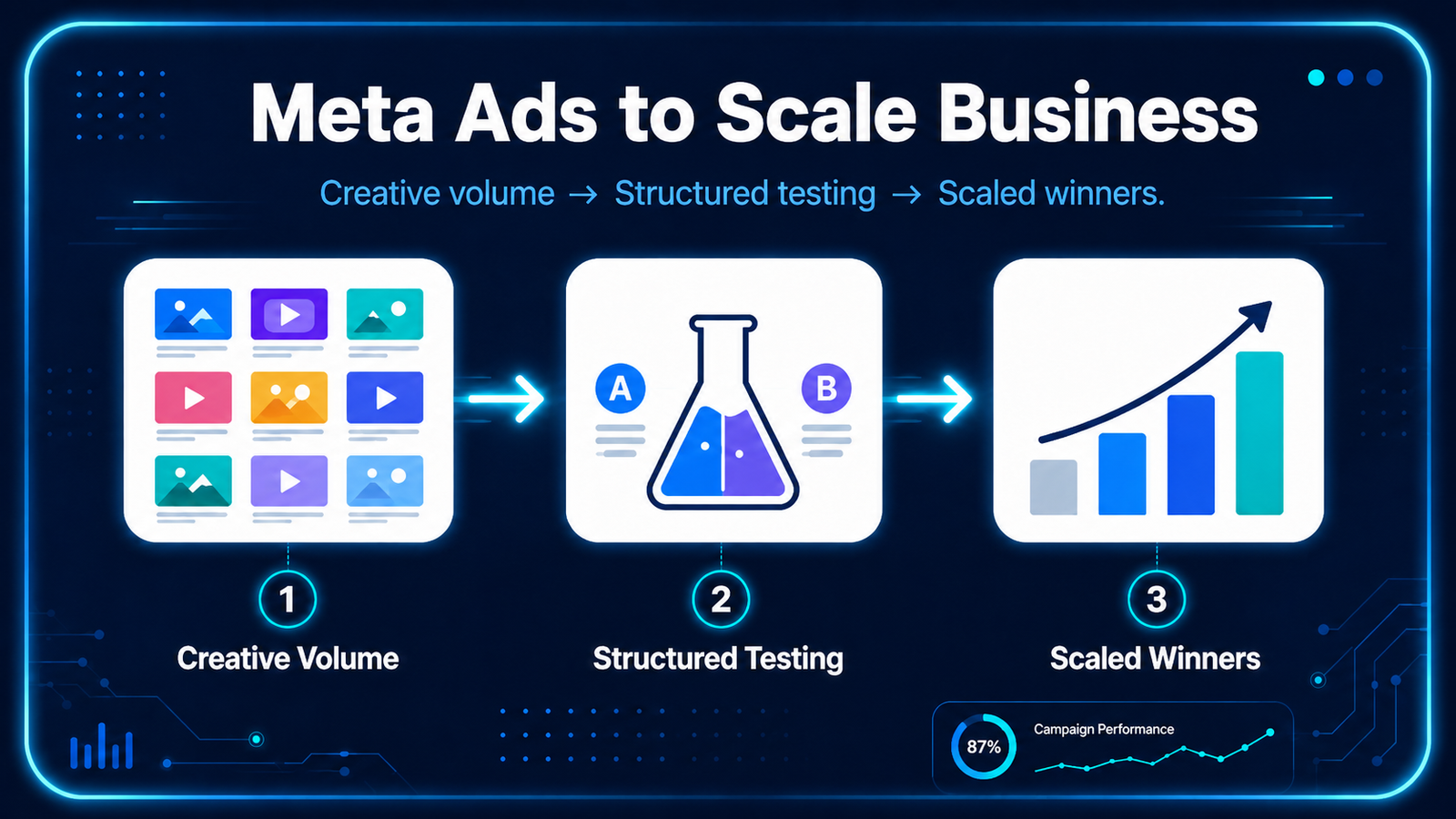
Most Virginia Beach businesses running Meta ads use two or three creatives, pitch cold traffic immediately, and quietly assume the platform just isn’t working. The operating model behind the best-performing direct-response accounts looks nothing like that — it floods cold audiences with volume before ever asking for the sale, treats creative as a renewable input, testing as a discipline, and lead handling as part of the ad account, not a separate department. This post breaks down that model and adapts it for Virginia Beach and Hampton Roads businesses.
What is a high-volume content funnel model?
Instead of showing a cold prospect one ad and asking for the sale immediately, this model floods the audience with a high volume of useful, relevant content first — tips, breakdowns, behind-the-scenes, proof — across many touchpoints before the pitch ever shows up. By the time the offer appears, the prospect already feels like they know the business. That familiarity is what makes the eventual ad convert instead of getting scrolled past.
Principle 1: Flood cold audiences with information before the pitch
A prospect who’s seen ten pieces of genuinely useful content from a business trusts it before the first offer ever appears. A prospect who sees one cold sales ad has no reason to trust anything. The funnel-style approach front-loads volume — tips, results, behind-the-scenes, proof — so the pitch lands on someone who already feels familiar with the business.
Educational Content First
Useful, specific content that earns attention before anything gets sold.
Multiple Touchpoints
The same prospect sees the business several times, in several formats, before the offer.
Familiarity Before the Pitch
By the time the ad shows up, it feels like the next thing, not the first thing.
Principle 2: Creative volume beats a handful of “safe” ads
Meta’s ad delivery system rewards accounts that feed it diverse creative concepts, not accounts running the same two ads for months. Creative quality and diversity now account for the majority of what decides whether an ad wins the auction at all.
Diverse Concepts
Different hooks, angles, and formats — not five versions of the same ad.
Multiple Angles
Price, urgency, trust, and results each get their own test, not one blended pitch.
Fed to the Algorithm
Enough creative volume for Meta’s system to actually find a winner.
Principle 3: Structured testing, not guessing
A test only means something if it was set up to produce a clear answer — a defined metric, enough budget, and enough time before anyone calls a winner.
Set Success Metrics First
Decide what a “win” looks like before launching, not after seeing results.
Give Tests Real Budget & Time
Enough spend and days to smooth out noise before making a call.
Kill Fast, Scale Faster
Clear underperformers get cut quickly; real winners get more budget immediately.
Principle 4: Offer economics before ad spend
No amount of creative testing fixes an offer that doesn’t make sense financially. The economics get worked out before the ad account gets scaled.
Know True CAC
What it actually costs to acquire a customer, all-in — not just ad spend.
Know LTV
What a customer is really worth once repeat business is factored in.
Price With Room to Advertise
Margin that can actually support paid acquisition at scale.
Principle 5: Lead handling makes or breaks the ad spend
A great ad campaign generating leads that sit unanswered for hours is just an expensive way to build a list nobody calls. Every dollar spent on Meta ads assumes the leads it generates get a fast, real response — which is exactly what speed-to-lead automation is built to guarantee.
Principle 6: Scale content and creative volume, not just budget
Jumping ad spend too fast resets Meta’s learning phase and tanks performance. Sustainable scaling means widening the content and creative pipeline first.
Diversify Concepts
New angles enter testing continuously, not just when performance dips.
Gradual Budget Increases
Scale spend in steps the algorithm can actually absorb.
Avoid Learning-Phase Resets
Big, sudden changes throw away weeks of optimization data.
What good Meta ads management should measure
Cost Per Lead
What each raw lead costs before any follow-up happens.
Cost Per Booked Call
What it actually costs to get someone on the phone or calendar.
Return on Ad Spend
Revenue generated against every dollar spent, not just clicks.
How the operating model flow works
Build Creative Volume
Multiple angles and formats enter testing at once, not one at a time.
Test With Discipline
Real budget, real time, a defined metric before calling any winner.
Route Leads Instantly
Every lead the ads generate gets an immediate automated response.
Scale What Works
Winning creative gets more budget; the pipeline keeps feeding new concepts in.
The account that only ran three ads for six months
It’s a familiar pattern: a business launches three ads, picks the one with the best early click-through rate, and lets it run. Performance is fine for a few weeks, then quietly declines as the same audience sees the same creative over and over. Nobody adds new ads because the original three “still work, mostly,” so the account slowly fades instead of scaling.
The accounts that keep growing do the opposite — new creative concepts enter testing every week, whether or not the current ads are struggling, so there’s always a next winner queued up before the current one fatigues.
⚠️ What Usually Goes Wrong
Two ads run for months, spend gets cut when they fatigue, and nothing new was ever queued up.
✅ What Makes It Work
New creative enters testing constantly, and winners get scaled the moment the data is clear.
Why this matters in Virginia Beach and Hampton Roads
Local service businesses often treat Meta ads as a switch to flip on and forget, which is exactly why so many Virginia Beach accounts plateau at the same monthly spend for years. A real creative and testing operating model turns the ad account into a system that keeps improving instead of slowly decaying.
How this works across Hampton Roads, not just Virginia Beach
The same discipline scales the same way in Chesapeake, Norfolk, Portsmouth, Suffolk, Hampton, and Newport News — creative volume and structured testing aren’t city-specific, they’re account-specific. What changes market to market is the offer and the audience, not the operating model underneath it.
The $50-a-day account that never scaled
A Hampton Roads home services business ran the same $50-a-day Meta ad campaign for over a year. It technically “worked” — a steady trickle of leads came in — but every attempt to raise the budget tanked performance within days. Nobody could explain why increasing spend seemed to make results worse.
The account had one ad set with two creatives, running the exact same way it had for twelve months. Raising the budget didn’t give the algorithm anything new to work with — it just pushed more money through the same worn-out creative to the same fatigued audience. The fix wasn’t a bigger budget. It was more creative volume feeding the budget that already existed.
The Hidden Problem
Raising budget on stale creative just spends more money on the same fatigue.
The Better Move
Widen the creative pipeline before — or instead of — raising the budget.
What a complete Meta ads operating model should do before scaling spend
- Confirm the offer’s economics support paid acquisition at scale
- Launch multiple distinct creative concepts, not variations of one ad
- Define the success metric and test window before launching
- Route every lead into an instant automated response
- Keep new creative entering the pipeline every week, win or lose
Is It Worth Fixing?
Which NyneCom path fits your business?
Once the math checks out, there are two ways to put this operating model to work — pick based on how hands-on you want NyneCom to be.
AI Eco System
Instant lead routing and follow-up automation for the leads your ads generate — built for teams running their own Meta ad account.
Explore AI Eco System →Elite C Suite
$5,000/month + 10% of trackable profit generated. NyneCom builds the creative pipeline, runs the testing, and manages lead handling end to end.
See Elite C Suite →
Built by Reginald “Reggie” Pinckston
Reggie leads NyneCom’s work across CRM, automation, and revenue-focused AI systems, helping Virginia Beach businesses turn ad spend into booked appointments and repeat revenue.
How to make this model safer and easier to measure
Content and creative volume only pay off if the leads they generate get handled fast — it’s worth reading how speed-to-lead automation turns an ad-driven lead into a booked call and how missed-call text-back catches the ones who call in instead of clicking through. For a deeper technical breakdown of post-Andromeda creative testing, this creative testing framework guide is a solid reference.
Frequently Asked Questions
What does “flooding cold audiences with content” actually mean?
It means showing a prospect several pieces of genuinely useful content — tips, proof, behind-the-scenes — before ever asking for the sale, so the eventual offer lands on someone who already feels familiar with the business.
How many ad creatives should a business run at once?
Enough distinct concepts — typically several at minimum — to give Meta’s delivery system real diversity to test against, not just one or two ads.
How long should a creative test run before judging it?
Long enough to smooth out day-to-day noise and gather meaningful data — a handful of days at minimum, not a same-day decision.
Where does AI fit in?
AI handles the instant response and routing for every lead the ads generate, so ad spend doesn’t go to waste waiting on a callback.
Some links below are affiliate links. If you sign up through them, NyneCom may earn a commission at no extra cost to you.



Ready to build a real Meta ads operating model?
See what your ad account could do with real creative volume and instant lead handling behind it.