
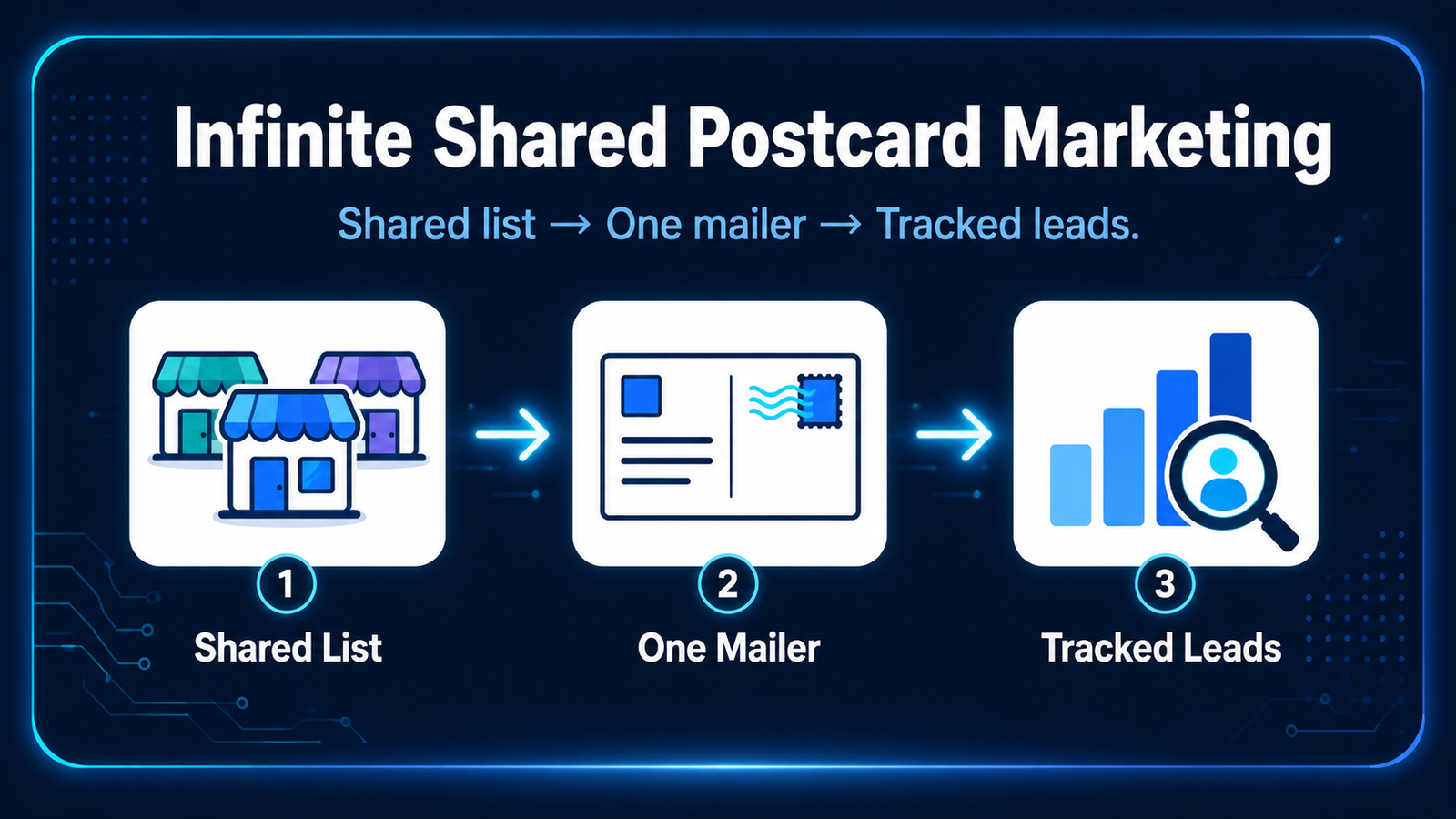
Direct mail still outperforms almost every digital channel — but most small businesses can’t afford to mail often enough, alone, to see the benefit. That’s the idea behind shared postcard marketing for Virginia Beach businesses: a handful of non-competing local businesses split the cost of one recurring mailer, each protected by category exclusivity, with responses tracked back to each business individually. For Virginia Beach and Hampton Roads businesses, that means an always-on mailbox presence at a fraction of what it would cost to mail alone.
Why direct mail still works when everything else is crowded
While inboxes get more crowded every year, mailboxes have gotten quieter. Industry response-rate data from the ANA/DMA puts the average direct mail response rate at 4.4% — about 37 times higher than the 0.12% average for email — and per-lead revenue analysis has found direct mail leads generating several times more revenue than digital leads.
4.4% Response Rate
The average across direct mail campaigns, dwarfing most digital channels.
37x Higher Than Email
Email averages just 0.12% by comparison.
17+ Days In-Home
A postcard sits on a counter for weeks; a digital ad disappears in seconds.
What should be in a shared postcard marketing program for Virginia Beach businesses?
Splitting the cost only works if every business gets real protection and real visibility into what its share actually produced.
Category Exclusivity
Only one business per category on the mailer — no direct competitors sharing space.
Split Mailing Cost
Design, print, and postage shared evenly across every business on the piece.
Individual Tracking
Each business gets its own QR code or number so results never get blended.
Which businesses make the best mailing partners?
The strongest shared mailers group businesses that share an audience but never compete for the same job.
Non-Competing Categories
An HVAC company, a roofer, and a landscaper — not three HVAC companies.
Similar Customer
Homeowners, in the same neighborhoods, with similar household budgets.
Local Service Area
Overlapping zip codes so the same mailer makes sense for everyone on it.
Recurring Need
Services people need again eventually, not one-time purchases.
What good shared postcard marketing should measure
A shared mailer only proves its worth if each business can see its own numbers clearly, not a blended average.
Response Rate
How many recipients acted on this business’s specific offer.
Cost Per Lead
The shared mailing cost divided by this business’s own responses.
Booked Revenue
Which responses actually turned into paying jobs.
How the shared postcard flow works
Build the List
Local homeowners across the shared service area, cleaned and deduplicated.
Split the Cost
Design, print, and postage divided evenly among the non-competing businesses.
Mail on a Schedule
A recurring drop — monthly or quarterly — instead of a one-off blast.
Track Each Business
Unique codes route every response back to the right business automatically.
The real advantage hiding in shared cost
A single mailer rarely builds recognition on its own. The businesses that see the biggest lift from direct mail are the ones that show up in the mailbox again and again, not once a year when the budget allows it. The problem is that mailing monthly, alone, is expensive enough that most local businesses simply don’t.
Splitting the cost across four or five non-competing businesses changes the math. Instead of one business affording a single mailer a year, five businesses can afford a recurring mailer every month — each one paying a fraction of the cost, each one getting its own tracked results.
⚠️ What Usually Goes Wrong
One business mails alone, can only afford it once, and the recognition effect never builds.
✅ What Makes It Work
Several non-competing businesses share the cost of showing up in the mailbox every month.
What this looks like with real numbers
The math is easier to see with an actual campaign than with percentages alone. Here’s a realistic version of how one shared mailer pencils out:
A batch of 10,000 postcards goes out through USPS Every Door Direct Mail (EDDM), targeted to carrier routes with higher household incomes so the mailer lands with homeowners who can actually afford the services being offered. Design, print, and postage for a run that size typically comes out to around $2,000.
Split eight non-competing businesses onto that same mailer — a roofer, an HVAC company, a landscaper, a cleaning service, and a few others who’ll never compete for the same job — and charge each one somewhere between $400 and $500 for their spot. That’s $3,200 to $4,000 collected against a $2,000 mail cost, which covers the campaign entirely and leaves $1,200 to $2,000 left over.
That leftover doesn’t have to sit as profit. It’s enough to fund the next mailer outright, or to put toward digital ads that reinforce the same message online. Run that cycle a few times and the mail cost effectively disappears — at that point, the businesses on the mailer are flooding their target neighborhoods with almost no out-of-pocket cost at all.
Why this matters in Virginia Beach and Hampton Roads
Virginia Beach neighborhoods are full of homeowners who need the same handful of services eventually — lawn care, HVAC, roofing, cleaning, home repair. A shared mailer puts several trusted local businesses in front of those same households on a recurring basis, without any one business carrying the full mailing cost alone.
How this works across Hampton Roads, not just Virginia Beach
The same model works across Chesapeake, Norfolk, Portsmouth, Suffolk, Hampton, and Newport News — local business groups splitting a recurring mailer by neighborhood, each protected by category exclusivity so nobody’s sharing space with a direct competitor.
The mailer that never got sent because nobody could afford it alone
A Virginia Beach landscaper looked at direct mail every spring. The quote always came back the same: a few thousand dollars for a single drop, maybe two if the budget stretched. One mailer a year barely registers with anyone — by the time a homeowner needs the service again, the postcard’s long gone. So the budget went to ads instead, and the mailer never got sent.
The math only worked once the landscaper split the cost with a roofer, a cleaning company, and an HVAC business — four non-competing services, one shared postcard, mailed monthly instead of once a year. Each business paid a quarter of what a solo mailer would have cost, and each one started showing up in the same mailboxes every single month.
The Hidden Problem
Mailing alone is often too expensive to do often enough to matter.
The Better Move
Split the cost with non-competing businesses and mail on a real schedule.
What a complete shared postcard program should do before the first mailer goes out
Before the first piece gets printed, the partners, the protections, and the tracking should already be locked in.
- Lock category exclusivity so no two businesses on the mailer compete
- Choose non-competing partners who share the same target household
- Agree on a recurring schedule, not a one-time drop
- Give every business its own trackable code or QR link
- Report response rate and booked revenue per business, not blended
Is It Worth Fixing?
Which NyneCom path fits your business?
Once the math checks out, there are two ways to put a shared postcard program to work — pick based on how hands-on you want NyneCom to be.
AI Eco System
Response tracking, lead routing, and follow-up automation layered into your CRM — built for teams running their own shared mail program.
Explore AI Eco System →Elite C Suite
$5,000/month + 10% of trackable profit generated. NyneCom finds the partners, builds the mailer, and runs the tracking end to end.
See Elite C Suite →
Built by Reginald “Reggie” Pinckston
Reggie leads NyneCom’s work across CRM, automation, and revenue-focused AI systems, helping Virginia Beach businesses turn shared marketing costs into a recurring, trackable lead engine.
How to make shared postcard marketing safer and easier to measure
A shared mailer only pays off if the leads it generates actually get followed up on fast. Once the postcards go out, the same discipline that recovers old leads and answers new ones matters just as much — it’s worth reading how speed-to-lead automation turns a response into a booked call and how database reactivation recovers the ones that went quiet. For broader direct mail benchmarks, this direct mail statistics roundup is a solid reference.
Frequently Asked Questions
What is shared postcard marketing?
Shared postcard marketing for Virginia Beach businesses is a recurring mailer split between several non-competing local businesses, each protected by category exclusivity and tracked separately.
How is my business protected from competitors?
Category exclusivity means only one business per category appears on the mailer — no direct competitors ever share the same piece.
How do I know which leads are mine?
Each business gets its own QR code, phone number, or tracked link, so responses never get mixed together.
Where does AI fit in?
AI routes and follows up on responses the moment they come in, so a shared mailer doesn’t turn into a shared inbox nobody checks.
Some links below are affiliate links. If you sign up through them, NyneCom may earn a commission at no extra cost to you.



Ready to build a shared postcard program?
See what a recurring, tracked mailer could bring in without carrying the full cost alone.